Events
Workshops, meetings, and the MINERALS seminar series.
2026 - 3 Events
Resolving the Earth's Mantle Composition

December 3 – 5, 2026, New York, USA
International House, 500 Riverside Dr, New York, NY 10027
The full conference schedule can be found here.
| Date | Format | Hours | Program |
|---|---|---|---|
| Thursday, Dec 3 | Full Day | 8:00 AM – 6:00 PM | 9 Talks |
| Friday, Dec 4 | Full Day | 8:00 AM – 6:00 PM | 9 Talks |
| Friday, Dec 5 | Half Day | 9:00 AM – 12:30 PM | 3 Talks + Wrap-Up |
NEW YORK — The MINERALS Project at Columbia University will host Resolving the Earth’s Mantle Composition, a two-day international workshop bringing together mineral physicists, seismologists, geodynamicists, and geochemists to confront one of the most consequential open questions in the Earth sciences: what the planet’s mantle is actually made of.
The workshop takes place on December 3–5, 2026, at Columbia University in New York and is convened by Prof. Renata M. Wentzcovitch, Principal Investigator of the MINERALS Project and a professor at Columbia’s Department of Applied Physics and Applied Mathematics and at Lamont-Doherty Earth Observatory.
The mantle accounts for the overwhelming majority of Earth’s volume, yet no sample of it has ever been recovered from depth. Everything known about its composition is inferred — from seismic waves that pass through it, from laboratory experiments that recreate its crushing pressures and temperatures, and, increasingly, from quantum-mechanical simulations that predict how minerals behave under conditions no experiment can yet reach. Each of these approaches produces a partial answer, and the answers do not always agree.
Determining the composition of Earth’s mantle remains one of the most fundamental and enduring challenges in the Earth sciences, with implications for planetary formation, thermal evolution, and geodynamic behavior. Despite decades of progress, key questions persist, including the bulk composition of the lower mantle, its spatial variability, and its relationship to the bulk silicate Earth. Competing constraints from geochemistry, geophysics, and mineral physics continue to yield divergent interpretations, reflecting both intrinsic complexity and observational limitations.
Recent advances are beginning to transform this problem. High-resolution seismic imaging, including full-waveform tomography, combined with improved mineral physics models, now enables joint interpretations of multiple observables. At the same time, new constraints from geoneutrino measurements, high-pressure experiments, and first-principles simulations provide independent insights into Earth’s composition and energy budget. Together, these developments offer new pathways to break long-standing degeneracies between temperature, composition, and phase transitions.
This workshop will bring together contributions that integrate observations, experiments, and theory to constrain mantle composition, explore its heterogeneity, and extend these insights to terrestrial planets and exoplanets.
Organizers: Renata Wentzcovitch and William McDonough
Support: Gordon & Betty Moore Foundation Award GBMF12801 (doi.org/10.37807/GBMF12801)
Confirmed speakers:
- Maxim Ballmer (University College London, UK)
- Laura Cobden (University of Utrecht, NL)
- Arwen Deuss (University of Utrecht, NL)
- Ed Garnero (University of Arizona, US)
- Damanveer Grewal (Yale University, US)
- Christine Hernlund (Earth Life Sciences Institute, Institute of Science Tokyo, JP)
- Kei Hirose (virtual) (University of Tokyo, JP)
- Shun-Ichiro Karato (Yale University, US)
- Tomo Katsura (Bavarian Geoinstitute (BGI) at University of Bayreuth, DE)
- Jun Korenaga (Yale University, US)
- Jung-Fu Lin (University of Texas at Austin, US)
- Maureen Long (Yale University, US)
- Chenxing Luo (Columbia University, US)
- William McDonough (Qingdao National Laboratory for Marine Science and Technology, PRC)
- Raj Moulik (Columbia University, US)
- Motohiko Murakami (virtual) (Swiss Federal Institute of Technology Zurich, CH)
- Robert Myhill (University of Bristol, UK)
- Kaveh Pahlevan (Carl Sagan Center for Research, SETI Institute, US)
- Paolo Sossi (virtual) (Swiss Federal Institute of Technology Zurich, CH)
- Paul Tackley (Swiss Federal Institute of Technology Zurich, CH)
- Renata Wentzcovitch (Columbia University)
They will be joined by members of the MINERALS research team at Columbia and partner institutions.
The meeting is organized under the MINERALS Project — Modeling Earth from Atomic to Global Scale — a multi-institutional research effort led from Columbia and supported by the Gordon and Betty Moore Foundation. MINERALS works across an unusually wide range of scales, from the behavior of individual electrons in iron atoms to the convection of the whole mantle, and the workshop reflects that span.
Recent work by the MINERALS team illustrates the approach. The iron spin crossover — a quantum-scale rearrangement of electrons within iron atoms under extreme pressure — changes how seismic waves travel through the lower mantle, meaning a phenomenon measured in angstroms leaves a signature detectable from the surface of the planet. Connecting effects at those two scales is precisely the kind of problem the workshop exists to address.
The workshop is by invitation. Further details, the program, and participant abstracts will be posted here.
About the MINERALS Project
MINERALS — Modeling Earth from Atomic to Global Scale — is a collaborative research project led by Prof. Renata M. Wentzcovitch at Columbia University, spanning Columbia’s Department of Applied Physics and Applied Mathematics, Lamont-Doherty Earth Observatory, and partner institutions. The project develops and applies first-principles computational methods to determine the properties of Earth-forming minerals and to link them to global-scale geophysical observations. MINERALS is supported by the Gordon and Betty Moore Foundation.
Media Contact
Lucie Lagodich Interim Project Coordinator, The MINERALS Project Lamont-Doherty Earth Observatory, Columbia University lvl2113@columbia.edu
Vishal Manve (Vishy) former Project Coordinator, The MINERALS Project Lamont-Doherty Earth Observatory, Columbia University vbm2109@columbia.edu
AGU Annual Meeting 2026 - San Francisco

December 7–11, 2026, San Francisco, CA
Abstracts presented by the Wentzcovitch Group:
- Small-scale convection rolls in groundwater beneath the Antarctic Ice Sheet generate geothermal heat flux anomalies and imply accelerated ice sheet retreat
- The dynamic topography, geoid, and lithospheric structure beneath Antarctica: Constraints from geodynamic models
- Amortized probabilistic inversion of lower-mantle thermochemical structure with conditional normalizing flows
- Coupled Mineral Physics of the Post-Perovskite Transition and the D″ Discontinuity
- Bulk Composition and Heterogeneity of the Earth's Mantle from the Reference Earth Model
- An internally consistent ab initio thermodynamic and thermoelastic dataset for Earth’s lower mantle
- Anharmonicity Expands the Stability Field of CaCl₂-Type SiO₂ in the Lower Mantle
- Constraining the drivers of Relative Sea Level Change in southern Alaska
- Sea level and ice sheet stability during past (and future) warming
- Insights into the controversial elasticity of lizardite
- From hydrogen-bond disorder to superionic proton transport in δ-AlOOH
- Modeling Post Glacial Rebound in Southeast Alaska to Estimate Little Ice Age Ice History and 1D Earth Structure
Sessions presented by the Wentzcovitch Group:
- Exploring Planetary Materials Through Computational Simulations and Machine Learning II Poster
- Resolving the Earth's Mantle Composition I Poster
- Progress in Understanding Core Compositions and Ionic Processes in Earth and Planetary Interiors II Poster
- Exploring Planetary Materials Through Computational Simulations and Machine Learning I GeoBurst
- Progress in Understanding Core Compositions and Ionic Processes in Earth and Planetary Interiors I Oral
- Resolving the Earth's Mantle Composition I Oral
- Resolving the Earth's Mantle Composition III Oral
- Exploring Planetary Materials Through Computational Simulations and Machine Learning III GeoBurst Poster
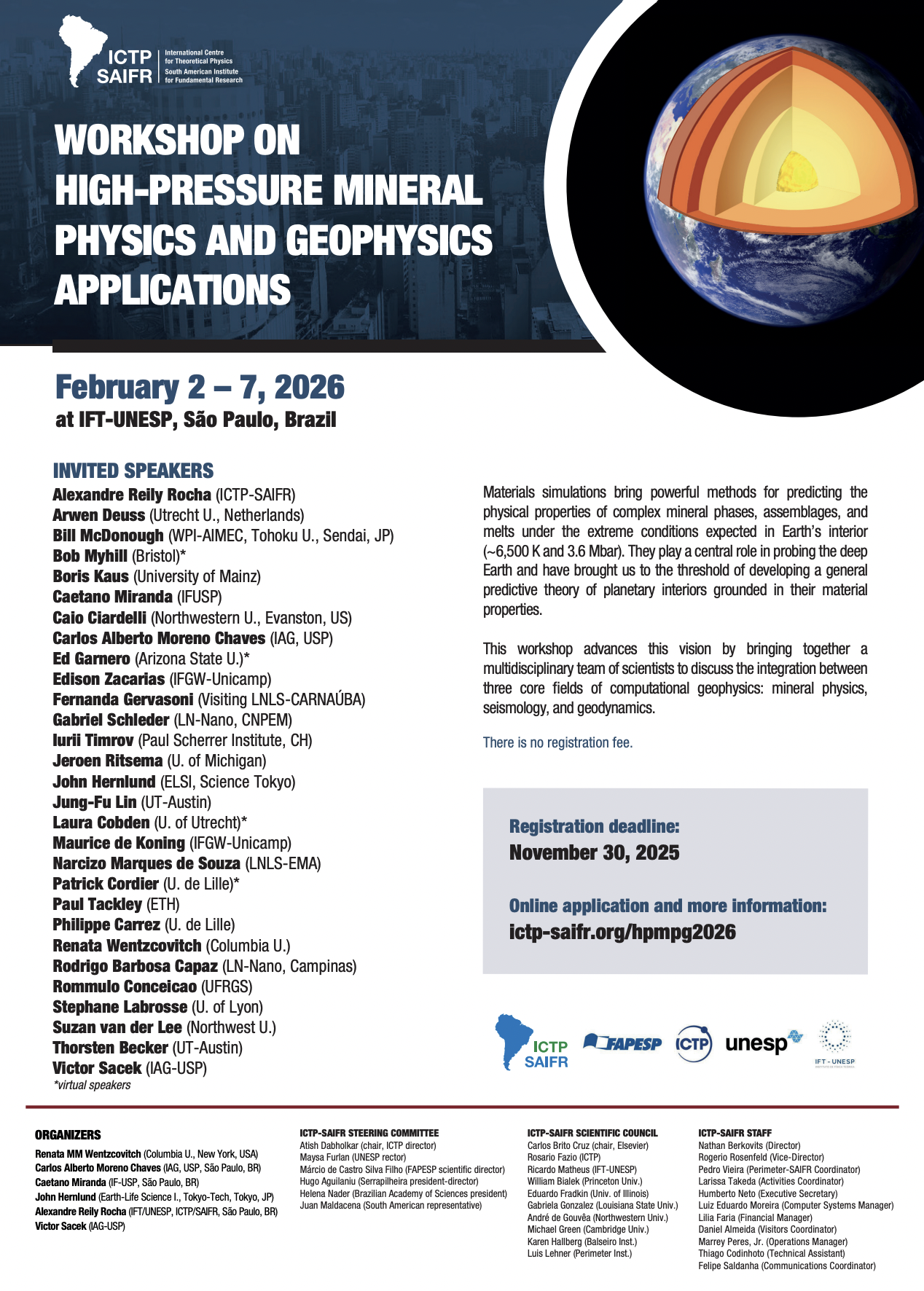
High-Pressure Mineral Physics and Geophysics Applications
February 2 – 7, 2026, São Paulo, Brazil
Multidisciplinary discussion between mineral physics, seismology, and geodynamics
Materials simulations bring powerful methods for predicting the physical properties of complex mineral phases, assemblages, and melts under the extreme conditions expected in Earth’s interior (~6,500 K and 3.6 Mbar). They play a central role in probing the deep Earth and have brought us to the threshold of developing a general predictive theory of planetary interiors grounded in their material properties.
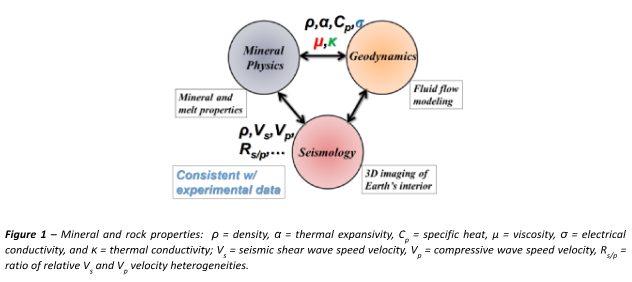
This workshop advances this vision by bringing together a multidisciplinary team of scientists to discuss the integration between three core fields of computational geophysics: mineral physics, seismology, and geodynamics.
The link to the event is here.
Organizers:
- Renata MM Wentzcovitch (Columbia University, New York, USA)
- Carlos Alberto Moreno Chaves (IAG, USP, São Paulo, BR)
- Caetano Miranda (IF-USP, São Paulo, BR)
- John Hernlund (Earth-Life Science Institute, Tokyo-Tech, Tokyo, JP)
- Alexandre Reily Rocha (IFT/UNESP, ICTP/SAIFR, São Paulo, BR)
2025 - 2 Events
AGU Annual Meeting 2025 - New Orleans
December 13–19, 2025, New Orleans
Abstracts presented by the Wentzcovitch Group:
- DI31A-01 – Fe–Ni Phase Diagram: Mineral Physics Implications for a Layered Inner Core
- MR13A-04 – Thermoelasticity of Geologically Relevant Silica Phases (SiO₂) Using Machine Learning Potentials
- MR13A-08 – Ferroelastic Hysteresis, Shear Modulus Softening, and the Tetragonal↔Cubic Transition in Davemaoite
- MR31B-0044 – Phase Transitions, Stability, and Thermodynamic Properties of Mg₀.₅Fe₀.₅O Under Super-Earth Conditions
- MR31B-0048 – Machine Learning Potential for Serpentines
- MR31B-0049 – The Fe–Si–O System at Terapascal Pressures
G51C-0184 – Quantifying Uncertainty in Glacial Isostatic Adjustment through Community Model Intercomparison Project: GIAMIP
APS March Meeting 2025 - Global Physics Summit
March 16–21, 2025, Anaheim
Abstracts presented by the Wentzcovitch Group:
- MAR-L49.4 – Effects of the pressure-induced H-bond disorder/symmetrization in δ-AlOOH on its phonon properties
- MAR-L49.1 – Deep learning-based simulations in geophysics
- MAR-W46.8 – Understanding the stability of superionic phases in Earth’s inner core
- MAR-W46.9 – Ferrous iron partitioning in the lower mantle: consequences for seismic velocities and heterogeneities
- MAR-W46.11 – Elastic softening in the tetragonal-cubic transition in davemaoite
- MAR-W46.12 – Machine learning potential for serpentines
2024 - 1 Event
AGU Fall Meeting 2024
December 9th - 13th, 2024 - Washington D.C.
Abstracts presented by the Wentzcovitch Group:
- MR22A-02 – Understanding the stability of superionic phases in Earth’s inner core (Invited)
- MR23B-03 – An ab initio study on the hydrous minerals: stability and elasticity of brucite
- MR21C-3217 – Deep-learning-based prediction of the tetragonal to cubic transition in davemaoite
- MR21C-3221 – H-bond disorder-symmetrization in δ-AlOOH under pressure: a view from phonon quasiparticles
- MR21C-3218 – Fe2+ partitioning in Al-free pyrolite: consequences for seismic velocities and heterogeneities
- DI11A-03 – Observational Evidence for Iron Spin Crossover and Chemical Heterogeneity in the Deep Mantle from both Body Waves and Whole Earth Oscillations (Invited)
Sessions co-organized by Renata Wentzcovitch
MR21C – Exploring Planetary Materials Through Computational Simulations and Data Analytics I Poster
MR23B – Exploring Planetary Materials Through Computational Simulations and Data Analytics II Oral
Primary Convener
- Jie Deng, Princeton University
Conveners
- Renata Wentzcovitch, Columbia University in the City of New York
- Jun Tsuchiya, Ehime University
- Bijaya B Karki, Louisiana State University