
Overview
Materials simulations bring powerful methods for predicting the physical properties of complex mineral phases, assemblages, and melts under the extreme conditions expected in Earth’s interior (~6,500 K and 3.6 Mbar). They play a central role in probing the deep Earth and have brought us to the threshold of developing a general predictive theory of planetary interiors grounded in their material properties.
This project advances that vision by connecting a multidisciplinary team of scientists to advance the integration between three core fields of computational geophysics: mineral physics, seismology, and geodynamics.
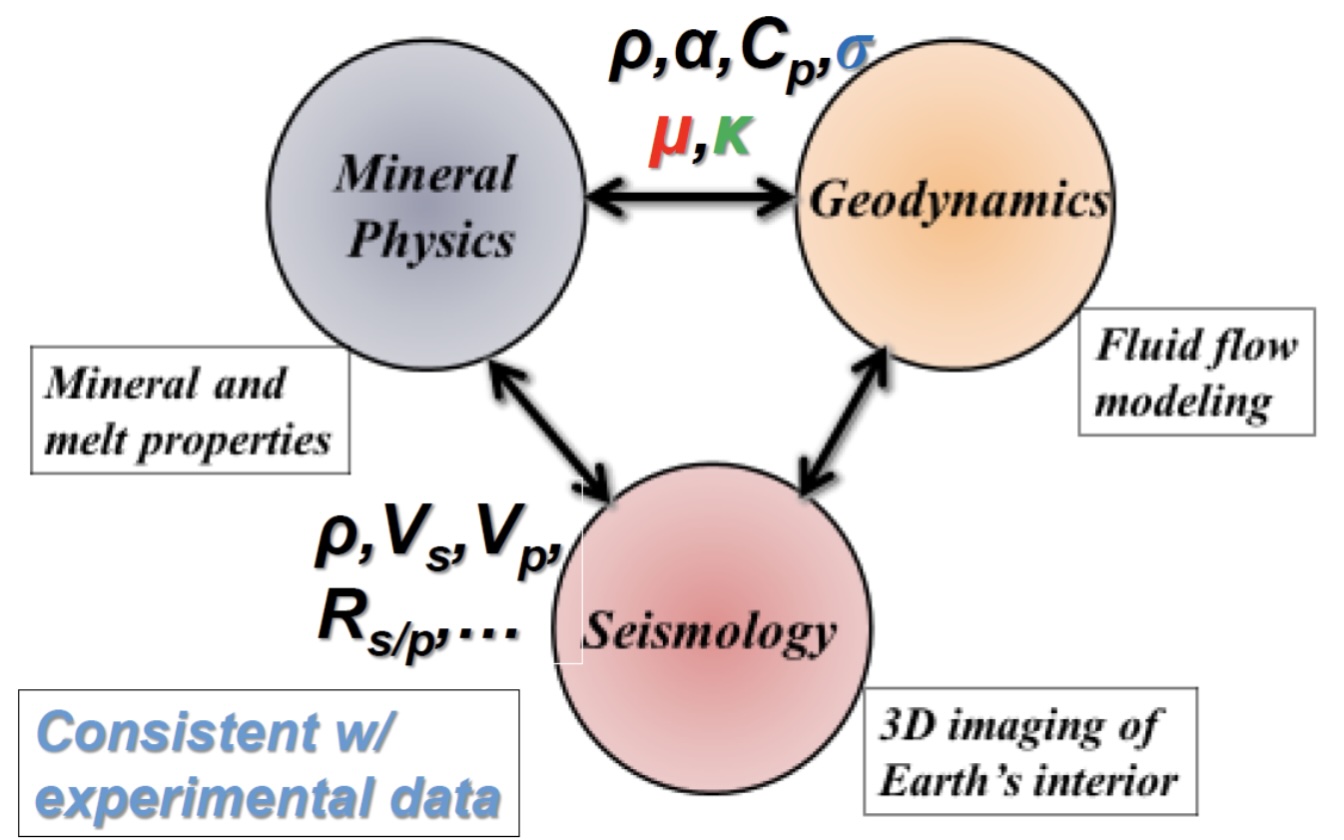
Figure 1 – Mineral and rock properties: p = density, a = thermal expansivity, Cp = specific heat, M = viscosity, σ = electrical conductivity, and κ = thermal conductivity; Vs = seismic shear wave speed velocity, Vp = compressive wave speed velocity, Rs/p = ratio of relative Vs and V, velocity heterogeneities.
xxxxxxxxxxxxxxxxxxxxxxxxxxxxxxxx
Overview
Materials simulations bring powerful methods for predicting the physical properties of complex mineral phases, assemblages, and melts under the extreme conditions expected in Earth’s interior (~6,500 K and 3.6 Mbar). They play a central role in probing the deep Earth and have brought us to the threshold of developing a general predictive theory of planetary interiors grounded in their material properties.
This project advances that vision by connecting a multidisciplinary team of scientists to advance the integration between three core fields of computational geophysics: mineral physics, seismology, and geodynamics.

Figure 1 – Mineral and rock properties: p = density, a = thermal expansivity, Cp = specific heat, M = viscosity, σ = electrical conductivity, and κ = thermal conductivity; Vs = seismic shear wave speed velocity, Vp = compressive wave speed velocity, Rs/p = ratio of relative Vs and V, velocity heterogeneities.